

With the total lack of Solar activity the last couple of years you can imagine how excited I got when a couple of prominences popped out of the Sun's chromosphere the other day. I was able to capture the prominences with my Canon 40D attached directly to my Coronado PST. This little scope allows a narrow band of the light spectrum through, the Hydrogen- alpha emission which blocks out the blinding white light and lets the beautiful Solar chromosphere through where all the action happens. Prominences are powerful explosions on the Sun which shoot tons of Solar plasma into space, the prominences above and below are 10 Earth diameters high.
As I was taking pics one of the neighbours asked if I was taking pics of the Sun again. You'd think that a camera attached to my scope pointed at the Sun would be a good clue,... yes.... yes it would, that is if they could see it, you see to prevent the glare of the Sun from reaching my camera and preventing me from seeing the Sun in my camera's LCD monitor I have a bath towel swung over me and the scope, odd picture to say the least. You can see the image above on Sky and Telescope's web site, cool.
All this activity was happening just after NASA announced in a press release that the Solar wind was at it's 50 year low. Seems the pressure of the Solar wind has dropped 20% since the mid 1990's. The long term implications could be quite serious. The Solar wind inflates our protective Solar System Heliosphere. The Heliosphere is like a magnetic bubble surrounding and protecting the planets from deadly cosmic rays originating from outside our Solar System.
Less solar wind pressure, less bubble, less protection, which means more cosmic rays, which will have a detrimental effect on any kind of space travel, more satellite damage and on top of all that there are some scientists that believe there is a link between climate change and cosmic rays.
To keep track of our Heliosphere and to see how the decreasing Solar wind pressure affect it NASA is launching the IBEX (Interstellar Boundary Explorer) spacecraft October 5th. The craft will keep track of our Heliosphere without actually having to travel to the edge of our Solar system to do it
Well there may not be a pot of gold at the end of the above rainbow, at least not for the Hubble. Hubble is down, one of it's vital pieces of equipment, the Control Unit/Science Data Formatter is broke, or at least one side of it, they are now trying to get the backup side B running. The Formatter stores and transmits all the science data from all the equipment on Hubble down to us on Earth, very serious problem. Needless to say the Shuttle mission to repair the Hubble will be on hold until NASA determines what their next move will be. If they do happen to get the Hubble up and running NASA will then have to make a decision whether or not to send another Control Unit up with the STS 125 crew for installation, I vote yes, what good is all the new fancy schmancy equipment if the backup unit dies.
I'll leave you now with a cool clip of some Solar prominences in action.
Tuesday, September 30, 2008
Solar Activity 1, Hubble Activity 0


Thursday, September 18, 2008
Hubble Gets A Facelift

Due to the phasing out of the Shuttle program by 2010, STS-125 due to launch October 10th. will probably be the final opportunity to patch and repair the 18 year old Hubble Telescope.
What a ride it's been, wow. This little scope that could has helped scientists figure out the age of the universe, around 13.7 billion years old, found numerous black holes, and imaged tons of beautiful images for people like you and me.
I remember the day I got my first computer and color printer, first stop, Astronomy Picture of the Day to print off tons of Hubble images, I still have them in binders today.
They have a very aggressive replacement/repair agenda planned out for Hubble. First off they will be replacing WFPC2, one of Hubble's major cameras with the 10x better WFCP3 as well as replacing the Scope's rechargeable batteries which power the Hubble's scientific instruments during the night time of each orbit.
They will also replace the Hubble's 6 gyroscopes, do you know that it has been working on only 2 since 2005? They will also replace a faulty Fine Guidance Sensor with a refurbished one and install thermal insulation to help keep the equipment at a cool running temperature.
Previous repair missions to the scope have usually just entailed removing or installing equipment, this time out they will be attempting to repair a couple, 1. The Advanced Camera for Surveys (ACS) and the Space Telescope Imaging Spectrograph (STIS) or as they call it, the Black hole hunter.
But that's not all folks, oh no , they will be installing a Cosmic Origins Spectrograph (COS), this will be a key instrument, answering some of the more profound questions of the cosmos such as how galaxies have formed and evolved. This makeover should give the Hubble another 5 good years of life, maybe as much as 10.
The image above may be the first ever actual photograph of an exosolar planet orbiting a star similar to our Sun, more info gathering has to be done before they can say conclusively that it is. The planet has 8x the mass of our Jupiter and is about 330 times out from it's Sun as we are from ours, the image was taken with the Gemini North Telescope in Hawaii. What I find interesting is, if it is actually orbiting at that distance away from it's Sun, just think of how many possible other planets are in between, very cool.
Last but not least, tomorrow night, get ready for another occultation/conjunction of the Moon and the Pleiades!! For around 60-90 minutes our Moon will cover then uncover some of the stars in the Pleiades cluster, chances are if you live in the east side of North America you'll get an occultation, the west part, a conjunction, the Moon will have uncovered the Pleiades by the time it rises in the west. Just look to the NE at Moon Rise to see the celestial magic, I love when those two get together, so pretty. I took the image above last night as a dress rehearsal, to get the lay of the land, exposure settings, access to the site, short cuts, in case a train gets in my way, ect., can't leave anything for chance, forecast is looking excellent, getting excited, stay tuned for pics.
I'll leave you now with a Moon Rise image I took tonight.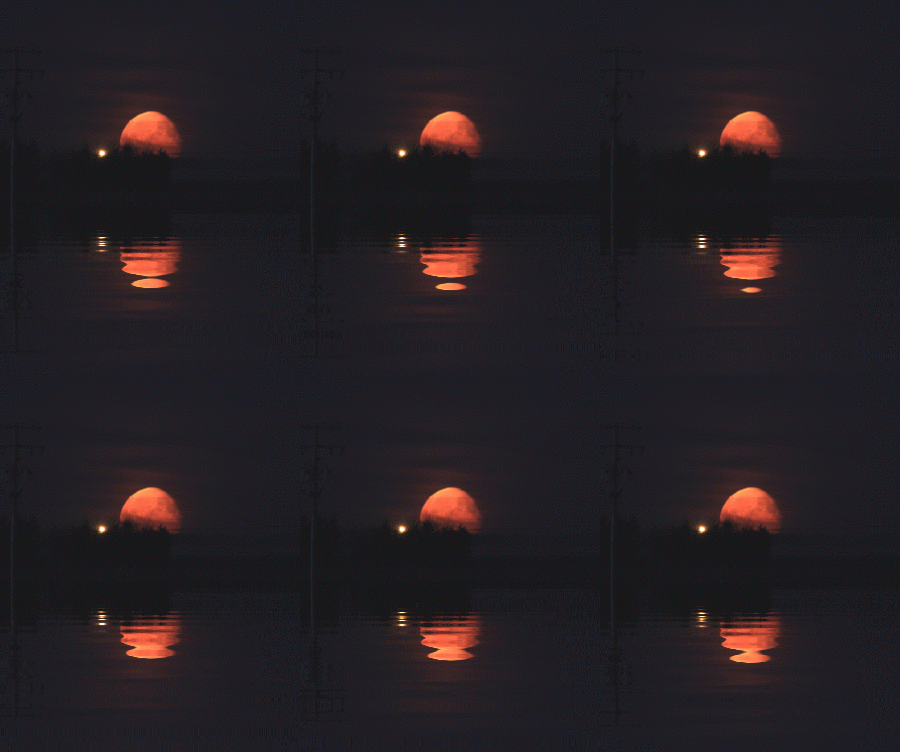
Tuesday, July 29, 2008
Aquarids, Draconids and Perseids

I know what you're thinking, your thinking my title is referring to a new "The Adventures of Sinbad" movie, you'd be wrong, although I wish they would make a new Adventures of Sinbad movie, the title is referring to the names of past and future meteor showers.
The image above is a Draconid meteor taken during the Dranconid meteor shower of June 29. I drew out the constellations for you to show you how everything fits in the night sky. I did the same for the image below of the Aquarid meteor shower back in May. The showers were literally back to back, 180 degrees apart, gives you a good idea of the major constellations in the spring sky in the Northern Hemisphere.
A point of interest, on the Draconid image I located for you the location where The Hubble Telescope was pointed for it's Hubble Deep Field image, (just above the arm of the Big Dipper).
NASA trained Hubble on an area in the sky no bigger then the size of a dime at 75 feet, pointed the scope away from the dust and stars of our galaxy, and away from the Virgo, Coma galaxy clusters, in an area they thought would be pretty empty of galaxies. What they discovered was astounding, after stacking 342 separate images over 10 days between December 18-28, 1995, they found at least 1,500 galaxies in various stages of evolution of up to more then 10 billion years ago, image below.
NASA thought that was pretty cool, so much so they thought they'd do it again, this time they aimed Hubble at a southern constellation Fornax, this time 800 images were taken over a 4 month time frame totaling 1 million seconds, this image is called the Hubble Ultra Deep Field and produced 10,000 galaxies, image below.
Back to the meteor showers. August 11 through to the early morning hours of August 12 the Perseid meteor shower peaks, look for 1-2 every minute, should be a good one. The radiant, or the place in the sky where the meteors seem to start from, is in the constellation Perseus. look low in the NE at Sunset for the start of the show.
NASA TV will be broadcasting live the Total Solar Eclipse Friday August 1 starting at 6:30 am EDT, that's right, hey it's 4:30 am where I live, I'll be up. The eclipse starts high up in North Eastern Canada, passes over Greenland, Russia, China and Mongolia. I vow to one day see a Total Solar Eclipse before I die, mark my words and if I still have a blog I will post tons of images, in the meantime it's NASA TV for me.
I'll leave you now with a clip of the Milky Way Galaxy I put together, 70 images, each at 30 seconds exposure, real time 45 minutes.


