Due to the phasing out of the Shuttle program by 2010, STS-125 due to launch October 10th. will probably be the final opportunity to patch and repair the 18 year old Hubble Telescope.
What a ride it's been, wow. This little scope that could has helped scientists figure out the age of the universe, around 13.7 billion years old, found numerous black holes, and imaged tons of beautiful images for people like you and me.
I remember the day I got my first computer and color printer, first stop, Astronomy Picture of the Day to print off tons of Hubble images, I still have them in binders today.
They have a very aggressive replacement/repair agenda planned out for Hubble. First off they will be replacing WFPC2, one of Hubble's major cameras with the 10x better WFCP3 as well as replacing the Scope's rechargeable batteries which power the Hubble's scientific instruments during the night time of each orbit.
They will also replace the Hubble's 6 gyroscopes, do you know that it has been working on only 2 since 2005? They will also replace a faulty Fine Guidance Sensor with a refurbished one and install thermal insulation to help keep the equipment at a cool running temperature.
Previous repair missions to the scope have usually just entailed removing or installing equipment, this time out they will be attempting to repair a couple, 1. The Advanced Camera for Surveys (ACS) and the Space Telescope Imaging Spectrograph (STIS) or as they call it, the Black hole hunter.
But that's not all folks, oh no , they will be installing a Cosmic Origins Spectrograph (COS), this will be a key instrument, answering some of the more profound questions of the cosmos such as how galaxies have formed and evolved. This makeover should give the Hubble another 5 good years of life, maybe as much as 10.
The image above may be the first ever actual photograph of an exosolar planet orbiting a star similar to our Sun, more info gathering has to be done before they can say conclusively that it is. The planet has 8x the mass of our Jupiter and is about 330 times out from it's Sun as we are from ours, the image was taken with the Gemini North Telescope in Hawaii. What I find interesting is, if it is actually orbiting at that distance away from it's Sun, just think of how many possible other planets are in between, very cool.
Last but not least, tomorrow night, get ready for another occultation/conjunction of the Moon and the Pleiades!! For around 60-90 minutes our Moon will cover then uncover some of the stars in the Pleiades cluster, chances are if you live in the east side of North America you'll get an occultation, the west part, a conjunction, the Moon will have uncovered the Pleiades by the time it rises in the west. Just look to the NE at Moon Rise to see the celestial magic, I love when those two get together, so pretty. I took the image above last night as a dress rehearsal, to get the lay of the land, exposure settings, access to the site, short cuts, in case a train gets in my way, ect., can't leave anything for chance, forecast is looking excellent, getting excited, stay tuned for pics.
I'll leave you now with a Moon Rise image I took tonight.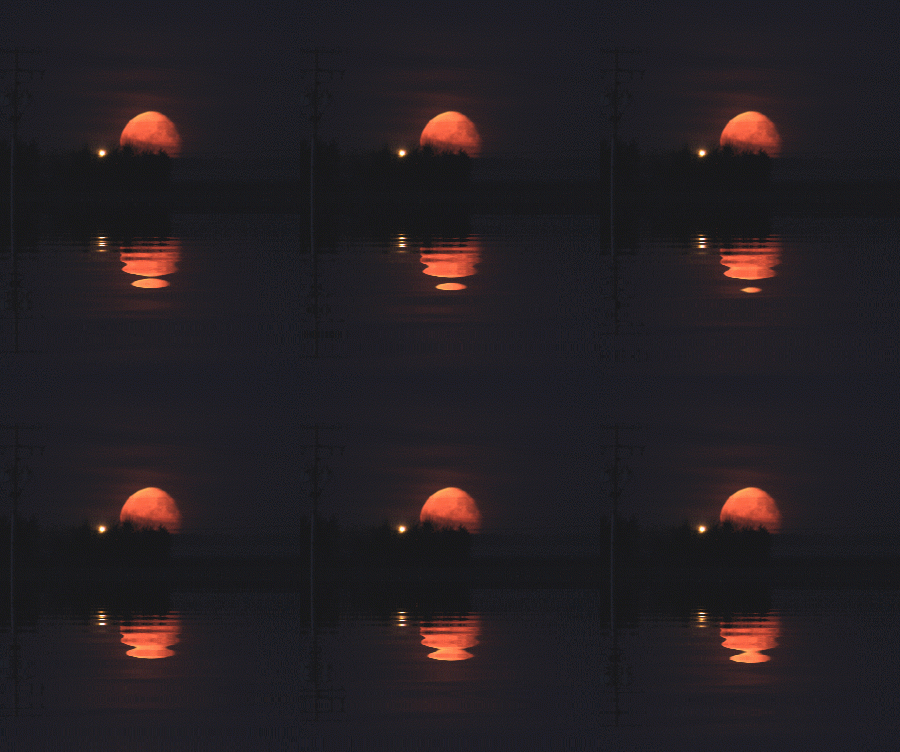
Thursday, September 18, 2008
Hubble Gets A Facelift


Monday, September 15, 2008
Creative Photography, Exosolar Planet

Imagine with me if you will, you are looking out of an entrance of a cave , onto the surface of a moon orbiting a Saturn type exosolar planet in a galaxy far far away, hey at least that's what I do. My Creative Photography contest image above was taken with my Celestron LCD Microscope while looking for micrometeorites, the black sphere in the middle of the image, I pasted an image of Saturn I took a year ago onto the microlandscape to complete the image.
The very cool thing about this microlandscape, besides the fact it has a micrometeorite in it, is I had just collected this sample from the down spout of my eaves and it was wet, so this microlandscape comes complete with it's own ecosystem so to speak, see the reflections from the surroundings, like the cave has water in it.
It's that time of year again, time for my favorite Full Moon. The image above is the September Full Harvest Moon. I took the image yesterday with my Canon 40D attached to my Meade telescope, I also added a touch of saturation to bring out the colors of the various minerals of the Moon, the blue for instance in the Sea of Tranquility indicates it is rich in Titanium.
I'd like to leave you now with a microlandscape animation.