

As far as I'm concerned there is nothing more pretty then a celestial gathering of the Moon and Pleiades.
We just had one August 14. Next groupings of the two are September 10, October 7, November 3, and December 1, do yourself a favor and look at the pairing on one of these nights using binoculars.
If you're so inclined just email me and I'll tell you where and when to look, you won't regret it. I think I can almost see the usefulness of tweeter in a case like this, might learn how to tweet to give you a reminder. What can I say, the Perseid meteor shower this year was probably the best shower I've seen in years. I missed the peak night due to clouds but was lucky enough to get some clear skies the following night, I later found out that this particular shower had 3 peaks, which is unusual, this year we happened through 3 distinct concentrated dust trails left behind by comet Swift Tuttle. The tiny dust particles aka meteoroids create the meteors aka falling stars we see by burning up through friction as they enter our atmosphere.
 Was treated to around 30 an hour and 5 fireballs, but the real cool thing was I didn't watch it alone. As I was pulling up to my regular viewing spot I noticed a car parked, as I got closer I noticed a couple people in it, a Mother and son. They had heard about the event, believe it or not, not through my blog but through a local radio station, they decided to venture out to see their first ever meteor shower, the looks on their faces when the first fireball came along was more exciting to me then the fireball itself. They had lots of questions and I did my best to answer them and at the end of the day they went away a little more in tune with the cosmos, a very special night for us all.
Next major shower are the Orionids, peaking October 21. Look to the South East at the Constellation Orion around 10:00 pm for the show to start.
Expect around 20 or so an hour. They are generally small, fast and have a slight color to them as in the above image I took last year. Notice the bright Moon, it took away a lot of the contrast so I was only able to spot the very bright meteors, not to worry, this year the Moon will be coming off it's new Moon stage and will have set by that time leaving us a dark sky in which to pick off even the faintest of meteors.
I'll leave you with an animation of a bamboo forest just outside of Shanghai.
Saturday, August 29, 2009
Moon, Pleiades and the Perseids


Thursday, September 4, 2008
Perseid Meteoroid Hits Moon

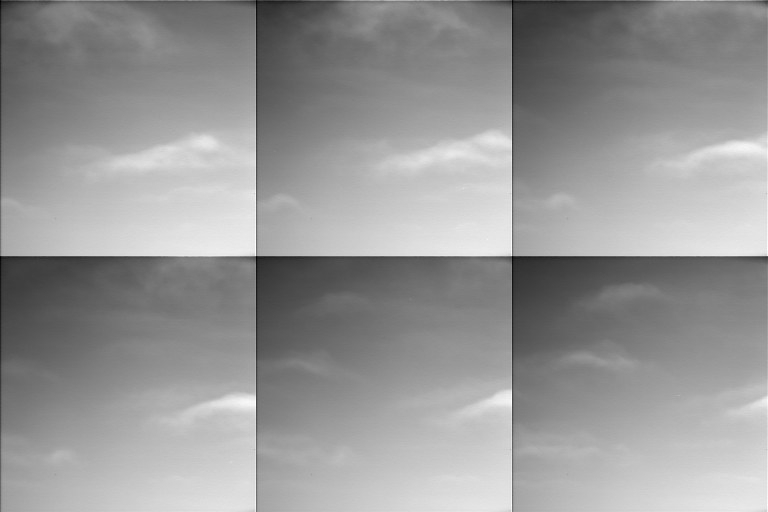
Some updates on the Phoenix Mars Lander, the above animation was taken with the Lander's surface stereo imager, it is a clip of 10 frames over a time frame of 10 minutes and shows ice clouds moving over the landing site. This helps scientists track winds on Mars, the clouds are made of ice crystals similar to the cirrus clouds here on Earth. The Lander has also gathered another soil sample into one of it's ovens. This sample came from the Stone Soup 7 inch deep trench, the deepest todate, "We are anxious to find out what makes this deeper soil cloddier than the other samples" Doug Ming, Phoenix science team member.

The little rover guys are still going strong, the above image shows the tracks of Opportunity coming back out of the Victoria Crater, notice two sets of tracks, it came back out over the same tracks it went into the crater with. Spirit's batteries are charging up again and is still doing science, both have made it through another Martian winter, a couple robots that were only to last 30 days have now been working for around 4 years, geez they keep going and going, the Phoenix should be so lucky.

Get thee over to Google Chrome, download this browser, it's fast and it's clean, it's a clean machine. The only problem with it I've found so far is that when you do your posts it doesn't underline like Firefox your spelling mistakes, which for me is quite a big thing, my posts usually have a gazillion words underlined, right now nothing is underlined, which means I've either spelled everything right or I'm screwed, so I may end up surfing the net with Chrome and then doing my posts with Firefox.
Tuesday, August 14, 2007
The Aurigid Meteor Shower and Lunar Eclipse

Just when you are coming down from a meteor shower high, another one comes along. Two thousand years ago in Roman times comet Kiess left a trail of dust behind, which on September 1st. between 3:45 and 5:15 am PDT. we will be able to view as meteors. Only 3 people alive today are known to have seen them. This is an extremely rare event and after this shower there wont be another Aurigid Meteor Shower for another 50 years.
The meteors radiate from the constellation Auriga which at that time in the morning will be directly above you and a little to the east. Because comet Keiss only generated a narrow trail of debris this meteor shower will only be viewable from western North America, the good news is there will be up to 200 bright meteors per hour and since they only last an hour and a half, it will be a wild ride.
Wednesday, July 11, 2007
"The sky is falling, the sky is falling"

Mark your calenders again, August 12,2007 is when we will be visited by the Perseids Meteor Shower. A couple of very important pluses this year. 1. There is a new moon this year which means you won't have the glare of the moon to interfere with your viewing, the sky will be darker therefore greater contrast and the meteors will show up better. 2. Mars will be in the sky as well, yeh! Mars will be in the NE part of the sky and will appear as a bright red object. If you dont have em, beg borrow or steal a pair of binocs for Mars (not for the meteors). You'll be able to see the shower from your backyard in the city, but to see the fainter meteors you'll have to venture a little ways out of town. As soon as it starts to get dark the show begins. To start with you should see a couple every minute, the frequency increases up to 20 or more a minute at its peak just before dawn. The Perseids get their name from the constellation Perseus, which is the radiant of the shower (where the shower appears to start from). Low in the north east to start, Perseus rises high in the sky just before dawn. When viewing showers focus your eyes between the radiant (NE sky) and the Zenith (sky directly above you) and get your fav lawn chair and relax. The shower itself is actually the debris trail of a comet discovered way back in 1862 named Swift-Tutle and every year the Earth in its orbit around the sun passes through it. The comets most recent visit was back in 1992. The debris field is made up cosmic dust cast off by the comet as it gets close to the sun. FYI, the cosmic dust is called a meteroid, once it hits the atmosphere it is called a meteor, once it hits the ground it becomes a meteorite.
The picture I have posted came from Slooh with permission. It is the comet lovejoy. I booked a 5 minute time slot with the robotic scope and took an image, get Slooh! its too cool for school.


