
UPDATE: It is confirmed asteroid 2008 TC3 hit the Earth's atmosphere around 750 miles southwest from the projected atmospheric impact area, this was confirmed by an Air France KLM airliner, the crew noticed a short flash just before the impact time. Apparently a few meteorites made it to the surface. The image below shows the infrared satellite image of the airliner (+) and the predicted impact area (0). As of right now there are no known images of the Fireball.
A small asteroid, 2008 TC3 was to have entered the Earth's atmosphere over Northern Sudan creating quite the light show last night, no pics so far, probably not a whole lot of camcorders over there. The above YouTube video is a simulation of what the Earth would look like from the approaching asteroid. As far as the asteroid, nothing too major about that, we get this size entering our atmosphere every other month or so, but what is interesting about this event is that this was the first time someone was able to predict when and where an asteroid was going to enter our atmosphere ahead of time, it's been tried before but with no success. I'm hoping there is more of the same to come, I'd love nothing better then to stand in my backyard with my camera awaiting the next arrival of a new born baby fireball.
Now the size of this asteroid ranged any where from a few meters to several feet and is not expected to do any damage if it happens to reach the surface, it's not the size I'm concerned with, I mean it's hard to give an exact size of something that far away, but can we pick a system people, I laid awake last night thinking, ... what was the size of it again? , 3 ft., 3 meters, no it was 10 meters, no 10 feet, geez. The first thing you notice when you get into amateur astronomy is we embrace both systems, I don't have just a 12 inch scope, I also have a 300 mm one, coupled with the fact that I also have a 8 inch 200 mm scope, too many numbers, too many numbers. I've resolved to the fact that my scopes no matter what size make stuff bigger. I'm also finding the older I get the less numbers I can remember so it would be great if we just let the old system go and delve into the metric system, it would make things a whole lot easier. The asteroid what ever size it ended up being was first discovered by the NASA funded Catilina Sky Survey with their telescope on Mt. Lemmon, image above. I will update this post as soon as more info becomes available. Hey while we're all waiting for some images of asteroid 2008 CT3, I thought I'd post the image below, it is a daytime fireball I was lucky enough to capture while taking an image of a Sunset last April, since it was only a few degrees from the Sunset I was imaging I had my camera equipped with a telephoto lens and focused, got it exploding.

On October 6 2008 around 4:40am EDT Messenger came within 125 miles of Mercury for the second time this year. The probe took 100's of images , gathered data and grabbed another gravity assist to slow it down for it's eventual orbital insertion with the planet in March of 2011.
Messenger started sending back images this morning around 1:50 am, the image above shows Mercury about 90 minutes after the probes closest approach. A lot of the eastern portion of the above image are views not taken by any spacecraft before. I will update this post as I receive more information.
I leave you now with an animated Moon collage I put together with the various Moon shots I have taken with my camera/various sizes of scopes.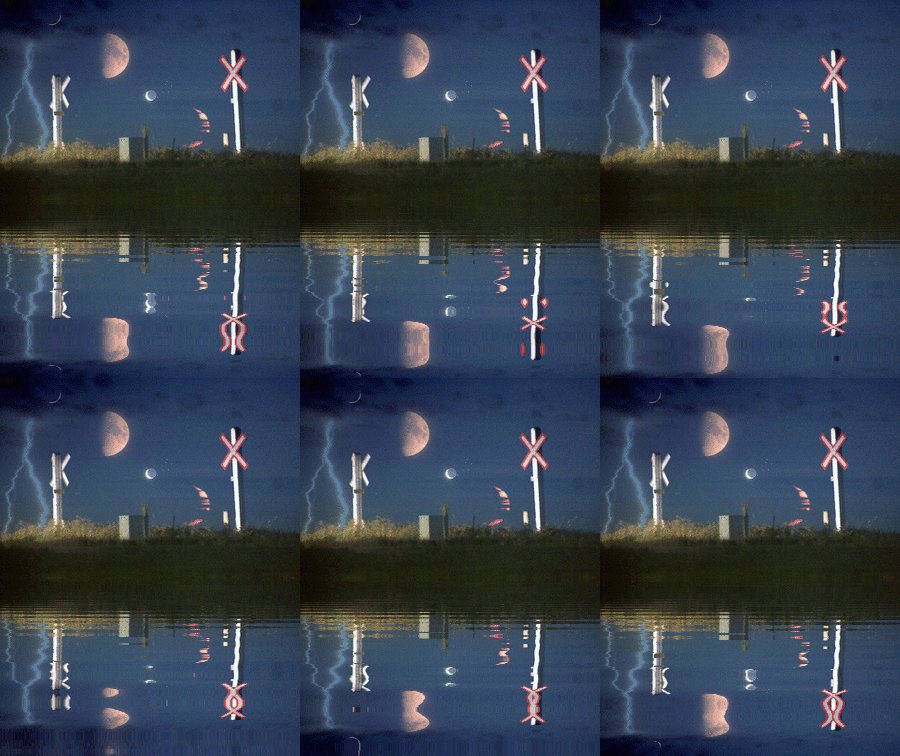
Tuesday, October 7, 2008
Asteroid 2008 CT3


Friday, October 3, 2008
Sikhote-Alin Meteorite
If you like old black and white Russian documentaries with English subtitles, boy have I got the film for you. Back in February of 1947 a huge meteorite fell to Earth in the Russian Sikhote-Alin Mountain Range. The Russians sent in a crew to retrieve and document the fall, the above movie is part of the documentary. I got permission to put the movie on YouTube from the person who did the subtitles, it is condensed down to nine and a half minutes to fit on YouTube, if you want to download the whole 18 minutes you can go to the originating web site here.
The Sikhote-Alin meteorite was witnessed by many people, it made a huge smokey trail and bang that could be viewed and heard for 30 km around the impact zone. The impact made 30 craters and left 28 tonnes of material behind.
The image above are a couple of actual Sikhote-Alin meteorites, the one on the left is called meteorite shrapnel because it looks like twisted bomb shrapnel, the meteorite on the right is a small individual piece of the meteorite, both were gathered back then.


The images above are pictures taken under a microscope of the meteorite at 40 times magnification. Witnesses say it looked like a bright star then turned into a fireball leaving a large smoke trail behind, it entered the Earth's atmosphere at around 31,000 mph. The samples are quite heavy and magnetic as they consist of around 90% iron.
October 6 the Messenger Probe will make another flyby of our planet Mercury. This will be the second flyby of our little planet by the probe. Messenger will come to within 125 miles of it's surface to gather another gravity assist to slow it down for the eventual orbit of Mercury in March 2011.
Messenger has 6 major scientific questions to try and answer.
1. Why is Mercury so dense?
2. What is the geological history of Mercury?
3. What is the nature of Mercury's magnetic field?
4. What is the structure of Mercury's core?
5. What are the unusual materials at Mercury's poles?
6. What volatiles are important at Mercury?
Once in orbit Messenger will gather data to try and answer the above questions, the mission is slated to last for one year, ending March 2012.
I'll leave you now with a Sunset I took a couple nights ago, the Sun is slowly setting earlier everyday, a sign that winter and the minus 40c weather is on it's way, so sad.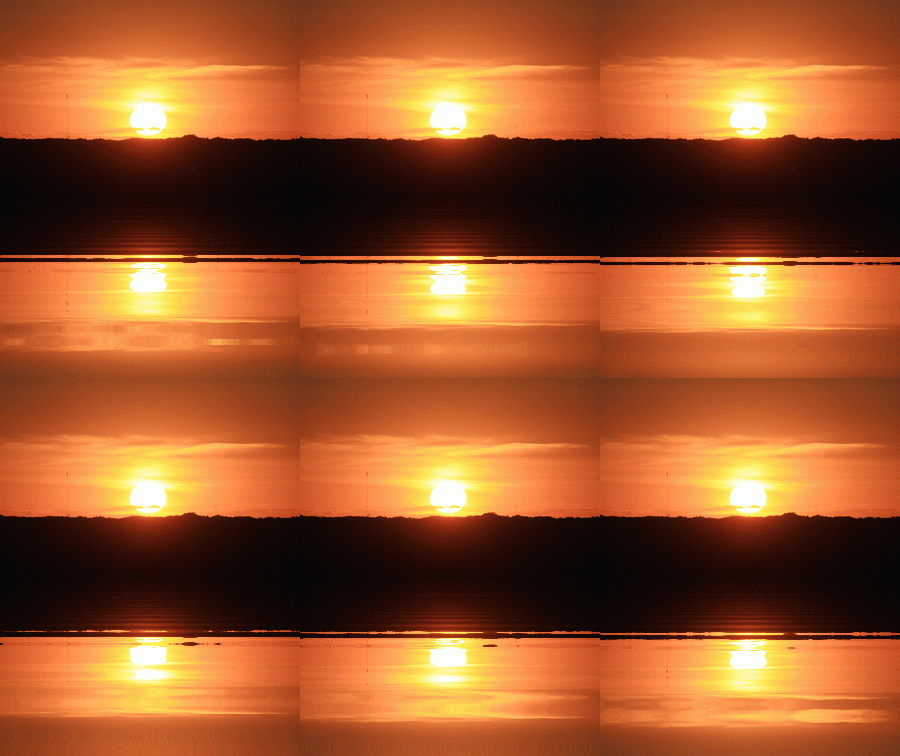
Wednesday, January 16, 2008
Picture Perfect Little Mercury

The above image of Mercury was taken about 17,000 miles out, 80 minutes after Messenger's closest approach of 126 miles. It is a view of Mercury never seen or imaged before.
Messenger made it's closest approach to Mercury January 14th. on it's long 4.9 billion mile journey to it's final goal of orbiting the tiny planet. That's right 4.9 billion mile journey, I know what you're thinking, "Bob have you lost your mind? what's this billion stuff? it's only 60 million miles to Mercury!". Yes I have lost my mind but that's totally besides the point, apparently because of Mercury's fast orbit and it's close proximity to the Sun, Messenger has to do a lot of planet flybys to decrease it's speed enough to obtain orbital insertion. To date Messenger has flown by Earth once, Venus 2 times and has 2 more flybys of Mercury in October 2008 and September 2009 before it obtains orbit of Mercury March 2011.

Will over at Healthy Living for People and Planet Earth brought up a good point in my comment section, Will asked why wouldn't the heat from the Sun burn up a man made probe to Mercury? Messenger has what they call a "sunshade" which amazingly enough protects the craft from the Sun and allows the electronics to operate at room temperature. We see what happens when the protective shielding doesn't deploy completely, like what happened with the first craft to visit Mercury Mariner 10.

Part of it's protective covering didn't fully open after launch rendering some of it's electronics and experiments useless. Mariner 10 made 3 passes of Mercury back in 1974/75, actually Mariner 10 was the first spacecraft to use the gravitational pull of a planet (Venus) to reach another(Mercury). Mariner 10 showed Mercury to be a cratered planet, it also showed Mercury to have a magnetic field, which is crazy talk, magnetic fields are usually associated with larger planets that spin rapidly, Mercury takes 59 days to rotate and it's molten core should have cooled off long ago. Messenger hopes to answer a lot of Mercury's unanswered questions, where does it's atmosphere come from, is it shrinking and why it is so dense with metals.
I have another One of my animated gifs for your viewing pleasure, a picture I took of the Andromeda Galaxy core back in the summer of 2007. Hey I have approximately lots more images to keep em coming till Messenger Orbital Insertion 2011.


